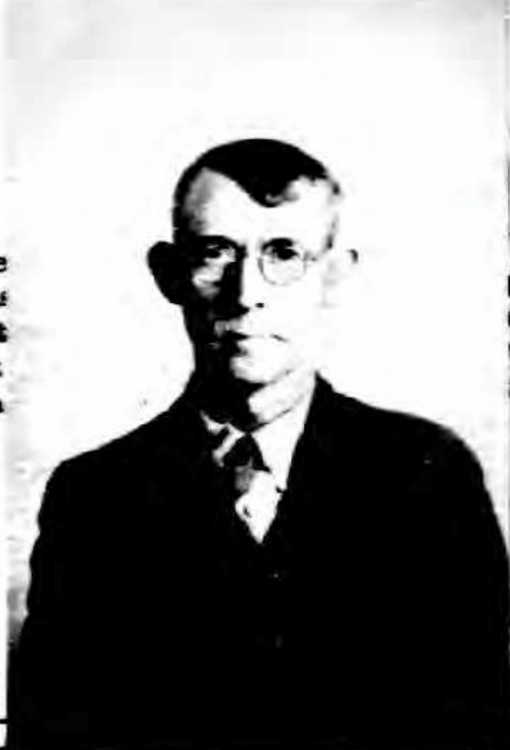
Henry (“Harry”) Wade
This rather stern looking individual is my maternal great-grandfather, Henry Wade, shown in his 1923 U.S. passport photo. In the passport application, Henry reported that his place of birth was Strokestown, County Roscommon, Ireland. Available records indicate that he lived there with his family until they emigrated to the U.S. in 1883 and settled in Essex County, New Jersey.
I have a lot of information about Henry and his family, but the starting point for telling Wade family story is Strokestown. By the way, I’ll refer to Henry as “Harry,” to distinguish him from his father Henry Wade.
Strokestown

The Town of Strokestown is located in the Province of Connaught, County of Roscommon, Barony of Roscommon, Annaghmore Electoral Division, and Civil Parish of Cloonfinlough. It is also encompassed in the Roman Catholic Parish of Strokestown.1
Both Harry and his parents Henry Wade and Ann Casey and their family members are documented in Strokestown and the surrounding area in civil records, including the Griffith’s Valuation, civil birth and death records, and Strokestown Parish records.
Griffith’s Valuation
A starting point for many in researching Irish family members is Griffith’s Valuation, a comprehensive land census that was conducted in Ireland in the middle of the nineteenth century. Griffith’s Valuation is an imperfect tool for tracing family groups because it is a land census, not a people census; it shows only lessors and lessees of properties, not family members who lived on the subject properties. Despite its limitations, however, it is an invaluable reference for genealogists.
Griffith’s Valuation was organized according to the Irish system of political divisions, i.e., province, barony, electoral division, etc., down to the smallest unit, the townland. Within each townland, individual properties were mapped and inventoried. Owners, lessors and lessees of property were listed, along with any subtenants, and their annual rents. The printed volumes detailing ownership information were accompanied by detailed maps showing the location of the individual leaseholds in each townland, identified by a corresponding map reference number.
Griffith’s Valuation was conducted to document land holdings for purposes of taxation. It was a massive undertaking that took two decades to complete. Click on the map image to access the online name search function for Griffith’s Valuation at the National Library of Ireland.

A name search for Henry Wade in Griffith’s Valuation yields an entry showing a Henry Wade as subtenant on farmland located in the Townland of Cloonfree. Cloonfree is located only a few kilometers from Strokestown. The Griffith’s Valuation entry for Henry Wade, Harry’s father, in Cloonfree, is shown in the image below, marked by a red arrow. Subsequent research in Strokestown Parish records that will be discussed below confirm that this record refers to my second great grandfather Henry Wade.

There is another Henry Wade who appear in Griffith’s Valuation in County Roscommon, located in a townland much further from Strokestown; he is discussed in the section “Other Wades in County Roscommon.”
The above entry in Griffith’s Valuation sheds some light on the economic circumstances of the Henry Wade family in 1857. The lower case letters next to Map Reference #32 denote the farmer (a) and the cottagers or laborers (b) through (f) who were the farmer’s sublessors. Thus, William Khair, (probably “Keher” or “Kerr”) subleased to five cottagers, including Henry Wade. Each sublessor had a “House, office & land.” Henry Wade’s sublease was the least valuable, worth an annual rent of only 1 £, 15 s. for the land, and 10s. for the house and office. It’s hard to give a modern equivalent for these figures, but the rent could have amounted to as little as $10 a year.

The immediate lessor of the property subleased by Henry Wade was Thomas Mahon, a member of an Anglo-Irish gentry family who were the landlords of thousands of acres in County Roscommon and elsewhere in Ireland. This lovely mansion was the seat of the Mahon family; it’s located just outside Strokestown. The mansion now houses Ireland’s National Famine Museum. Click on the photo to learn more about the relationship of the Mahon family in the Great Famine, and how their Strokestown mansion came to be the the location for the Museum.
The Townland of Cloonfree
Below is an image from the Griffith’s Valuation map that shows the Townland of Cloonfree as it was mapped in 1857. The entire townland is outlined in blue; the distance end to end (left to right) is about 3 miles.2 The Town of Strokestown is shown in the upper right of the map. The green circle shows map reference #32, where Henry Wade was a lessee.

The Townland of Cloonfree has changed very little since 1883. It remains a rural, agricultural area of green fields and open views, with properties divided by hedgerows and stone walls that largely correspond to the parcels delineated in Griffith’s Valuation in 1857.
The image below left is a closeup s Map Reference #32 in the Townland of Cloonfree on the 1857 Valuation map. On the right is a satellite image of the same area today, with Map Reference #32 lightly marked in yellow. Click here for a Google Maps satellite view centered on Lot #32.
Would you like to move near Cloonfree? In 2020, you could get a 19-acre property in nearby Cloonslanor Townland for only 90,000 Euro. The property is just a short walk from the Wade family home place in Cloonfree in one direction, and Strokestown in the other direction. According to the for-sale listing, this property is a fixer-upper with “a derelict cottage which would be an ideal renovation project.” The property has lake frontage on Cloonfinlough and, as you see, lovely views. The property is no longer listed as of 2024, but if you click on the image that I shamelessly stole from the realtor’s website, it should bring you to current listings in Strokestown and environs.

Henry Wade and Ann Casey
In Ireland in the early to mid-nineteenth century, vital records were kept primarily by religious institutions, either the local parishes of the Catholic Church, or in the case of Protestants, the established Church of Ireland. Unfortunately, the Roman Catholic parish records were not well-kept, for a variety of reasons. Depending upon the individual parish, they are fragmentary and damaged, and the handwriting is difficult to read. Deciphering and indexing is complicated by the fact that these records are usually written in Latin.
Another feature of these records is the lack of standardization. Especially in the early part of the nineteenth century, parish records consist of a simple, general purpose ledger, not a book designed for the purpose. The particular information recorded as to each event tends to be consistent for a period of time (perhaps reflecting the tenure of a particular priest). Thus, for example, not all entries for baptisms record the residence of the parents.
For our ancestral Henry Wade family group, parish records, such as they still exist, are found in County Roscommon in the Diocese of Elphin and the Parish of Strokestown. The earliest record that can be reliably linked to our Wade family is the marriage of Henry Wade and Ann Casey in 1850.3
- 1850 Marriage of Henry Wade and Ann Casey
Transcript: 1850 September 1 – Marriage, Henricum Wade – Annam Casey, Test Martin Tarpy & Catherine [Har ?]

The record of the marriage does not indicate where Henry and Ann were living at the time of their marriage, but it is likely that Ann, at least, was from the Parish of Strokestown, as marriages traditionally took place in the home church of the bride. This marriage record contains no indication of the names of the parents of either Henry or Ann.
The Children of Henry and Ann
The available baptismal records for the children of Henry and Ann are as listed below. The civil records show that this is not a complete list of their children.
- 1858 Baptism of Brigid Wade
Transcript: 1858 July 1, Henricum Wade – Annam Casey, SS Patricius Geoghan & Margareta Conry - 1861 Baptism of Alicia Wade
Transcript: 1861 February 2 – Baptism, Aliciam, parents Henrici Wade & Anna Casey, SS Jacobo Flanagan & Elizabetha Leonard [?] - 1868 Birth and Baptism of Joseph Wade.
Transcript: 1868 July 13 – Birth, Josephes, parents Henrici Wade & Anna Casey, Cloonfree, Baptism, September 10, 1868, probably “Patrick,” Geoghahan & Catherina [ – ?] - 1871 Baptism of Anna Wade.
Transcript: 1871 November 10 – Baptism, Anna Wade, parents Henrici Wade & Anna Casey, Cloonfree, Martino Duffy & Catherina Murran [Murray ?] - 1874 Baptism of Edward Wade.
Transcript: 1874 October 17 – Baptism, Edvardus, parents Henrici Wade & Anne Casey, Cloonfree, sole Margarta Casey
Only five children of Henry and Ann are reflected in these parish records. To identify all of the Wade children it is necessary to jump forward in the narrative, to the family’s emigration to the U.S. and their residence in Essex County, New Jersey, starting in 1883.
Henry and Ann and five of their children emigrated to the U.S. as a group in 1883 on the S.S. Helvetia, a passenger ship that regularly made the round trip from Queenstown (now Cobh) Ireland to the U.S. The passenger manifest for the voyage shows a group of seven passengers:
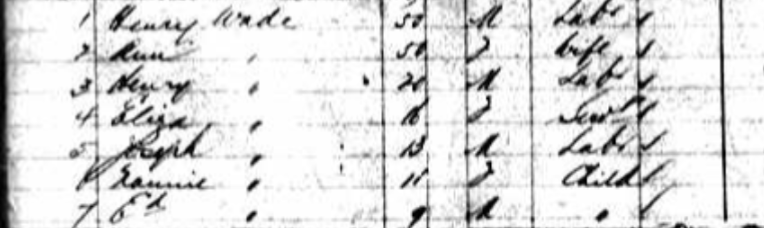
- Henry Wade, 50, laborer
- Ann Wade, 50, wife
- Henry, 20, laborer
- Eliza, 16, servant
- Joseph, 13, laborer
- Nannie, 11, child
- Ed, 9, child
The names of the five children in the passenger list square up with the available birth records in Ireland, with the exception of Harry, for whom no civil or baptismal record has been located. The passenger list also squares up with the U.S. and New Jersey census records compiled in my Ancestry.com tree.
The 1900 U.S. Federal Census elicited information on how many children a woman had given birth to, and how many were then living. At this time, Henry and Ann were living in Glen Ridge, New Jersey. Ann’s answer (or one given on her behalf) indicated that she had borne ten children, and that seven were then living.

When I began working out the names and birth order of the Wade children, my starting point was the seven individuals for whom I then had good information in Irish and U.S. records: Brigid, documented in an 1858 Strokestown Parish baptismal record; James a/k/a John, who is documented in Irish court records and subsequently in U.S. census and vital records; Henry, who is documented for the first time in the S.S. Helvetia passenger record in 1883; and Alicia, Ann, Joseph, and Edward, all of whom are documented in civil birth or parish baptism records in Strokestown. That makes seven children. Where are the three “missing” Wade children?
Other than completing the story of the Wade family, my purpose in working out the birth order of the Wade children was to determine if I could get a clue to the names of the parents of Henry and Ann by reference to Irish naming traditions that were prevalent in the nineteenth century and earlier, especially among poorer families. In that tradition, children are named after a relative, according to their birth order. As shown in the graphic below, the naming pattern for sons is paternal grandfather, maternal grandfather, father, and then on to uncles in a similar pattern. The pattern for daughters mirrors the male pattern: paternal grandmother, maternal grandmother, mother, then on to aunts.

Deviations from these patterns occurred for many reasons, but one common one was the high rate of infant mortality. When infants were named but died shortly after birth or when very young, the parents often chose to reuse a family name for a subsequently born child, particularly if the name had special significance to the family. I have found support for this phenomenon in the naming of both sons and daughters of Henry and Ann.
Through subsequent research and review of already obtained documents, plus some rank speculation, I believe I have discovered the “missing” Wade children.
The first missing Wade child, a first-born son likely named John, is completely undocumented and his existence is speculative. However, I believe a strong case can be made that he was born between 1851 and 1857. His existence makes his brother Henry the third son of Henry and Ann rather than the second son, which fits Henry into the traditional naming pattern (third son named after the father). John’s birth and early death also explains the otherwise curious phenomenon of his brother James being referred to alternately as “John,” “James John,” and “John James.”
The second missing child is a daughter, Alicia, born in 1861, who probably died as an infant. I discovered her in a mis-transcribed Strokestown Parish baptismal record, discussed below. The mis-transcription has led to her being confused with the daughter born in 1866, also named Alicia.
The third missing child is a son, also named John, who was born and died in 1875. His death, although not his parentage, is documented in an Irish civil death record discussed in order below.
The chart below sets out my theory of the identity and birth order of the 10 children of Henry Wade and Ann Casey, organized according to traditional Irish naming patterns. The anchors on the chart, if you will, are son Henry and his sister Ann as the third son and daughter, named after their father and mother respectively.
Based on this chart and the research underlying it, I posit that Henry Sr.’s father was named John Wade and his mother was named Alicia or Alice, or possibly Elizabeth (surname unknown), and that Ann Casey’s father was named James Casey and her mother was Brigid (surname unknown). The evidence supporting my conclusions is set out below the chart.
While most of the information supporting this chart is quite reliable based on the original records that I reviewed, some of my conclusions are highly speculative. Those conclusions are noted with a question mark. I have an open mind about these conclusions, and I would greatly welcome any ideas or even the tiniest scraps of information that might shed light on the identity and birth order of Henry and Ann’s children.
The columns below, from the left, indicate (1) the name that would be expected if the traditional naming pattern for sons was followed; (2) the actual names of sons of Henry and Ann; (3) the birth order of the actual Wade sons and daughters; (3) the actual names of daughters of Henry and Ann; and (4) the name that would be expected if the traditional naming pattern for daughters was followed.
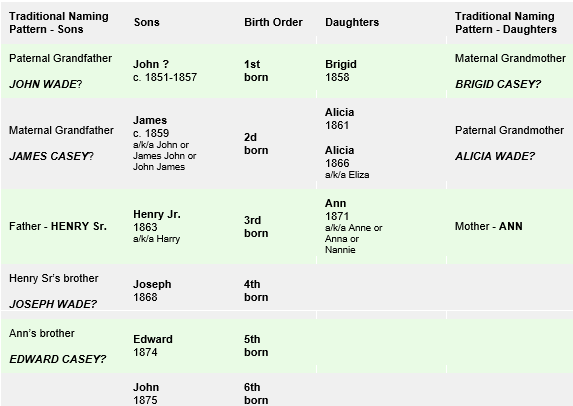
Note that Henry and Ann were married on September 1, 1850, thus the earliest date for their first child, assuming a full-term pregnancy and no premarriage shennagins, would be about June 1851.
Below is my analysis of the information on each child or possible child I’ve identified, according to their birth order in the above chart:
John Wade – Date of birth unknown; between 1851 and 1857.
In order to make the Wade family children fit into the traditional Irish naming pattern, my great grandfather Henry Jr. should be Henry and Ann’s third son, and thus two sons should have been born before Henry. I have only been able to reliably document one son born to Henry and Ann before Henry Jr.; that is the individual who is referred to in surviving Irish records, and some records in the U.S., as John Wade, born around 1859. I will frequently refer to this individual as “James a/k/a John.” James will be discussed more fully below, in order.
Accordingly I have concluded that Henry and Ann’s first child was named “John” and died as an infant, some time between 1851, the earliest possible birth year for a Wade child, and 1857, before the next documented child, Brigid Wade was born in 1858. It seems odd that Henry and Ann would have had no children in the years between their marriage in 1850 and the birth of Brigid in 1858. It seems especially odd considering that Ann by her own account birthed ten children.
Note that I have also discovered a record suggesting that Henry and Ann may have had a second, much later son named John Wade, born in 1875. He would be their tenth child. That record is discussed in order below.
Brigid Wade, baptized July 1858 in Strokestown Parish, of Henry Wade and Ann Casey.
Brigid appears to be the first born female child of Henry and Ann. She is not accounted for in surviving records after her baptism. I’ve searched Irish parish records and later civil records using various search patterns to come up with a Brigid Wade who corresponds to this child of Henry and Ann. It is possible that there is no further identifiable record of her because she married and no record of her marriage survives that would provide a married surname to track.
It is also possible that Bridget emigrated to the U.S. or elsewhere before the rest of the family. By 1883 when the family departed Ireland, Brigid would have been 25 years old, well into the typical marriage age range for Irish women. It is well-documented that marriage prospects for Irish women were bleak during the 1870s and ‘80s due to adverse economic conditions, and many chose to emigrate, even apart from other family members. Unfortunately, there are more than a few individuals named Brigid Wade in manifests of ships arriving in U.S. ports during the relevant period, and there is no way to reliably connect any of them to our Brigid Wade.
It is possible that Brigid died before 1900, but if she did, then we are missing another Wade child needed to make up the “seven then living” to whom Ann referred in the 1900 census return. I am hopeful that some record of Brigid Wade will show up when we extend our connections to remote family members via (corrected!) trees on Ancestry.com and through DNA comparisons.
James (a/k/a John, or John James, or James John Wade) born approximately 1859.
This is the “John Wade” who emigrated to the U.S. at some point prior to 1883, and is shown in the 1885 New Jersey census with his wife and child, living at the same address in Glen Ridge as his parents Henry and Ann. No baptismal record has been located for him in Ireland, and he was born before civil registration of Roman Catholic births in 1864, so there is no civil birth record for him.
I believe that James a/k/a John was likely the second son of Henry and Ann, and that he was born and baptized as either James Wade or James John Wade, or even James Henry Wade (in accordance with his death record). James’ direct descendant, my cousin John Marder, provided me with an important clue when he confirmed that his great grandfather John Wade was referred to as both John Wade and James Wade in various U.S. records. This “double naming” of James Wade suggests that upon the death of their first born son, Henry and Ann wished to preserve the name John and thus added it to the name of their second son James, perhaps as a middle name or nickname.
James first appears in surviving Irish records in the ledger of the Petty Sessions Court in Strokestown in 1878. In one record, he is shown as “John Wade of Cloonfree,” a defendant in a dispute with the Fury family, along with his father Henry. John next appears in identified surviving records in the U.S., in the aforesaid 1885 New Jersey census and then again in the 1895 New Jersey census, as “James Wade,” living in Harrison, N.J. with his growing family. These New Jersey census records are not helpful in pinpointing his birth date, however, as they give only an age range of 20 to 60 for John.
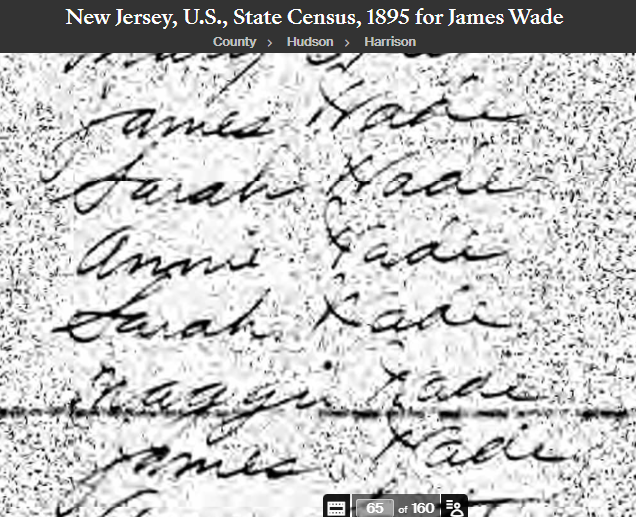
- James Wade
- Sarah Wade
- Annie Wade
- Sarah Wade
- Maggie Wade
- James Wade
In the 1900 Federal Census, enumerated on June 6, 1900, “John Wade” is still living in Harrison. His birth is reported as having occurred in December 1859. This date fits his birth neatly into the 30-month gap between the baptism of Brigid Wade in July 1858, and the baptism of the first daughter named Alicia in February 1861. The year of his immigration is given as 1878, indicating that he left Ireland five years before the rest of his family.
James died on August 4, 1900, after the census canvass on June 6. Find-a-Grave records his name as “James Henry Wade,” his age as 40 and his place of death as 310 John St, East Newark, NJ (adjacent to Harrison, NJ). Note that in the baptismal record for at least one of his children, his name is recorded as “James J. Wade.”
Incidentally, echoes of the traditional Irish naming pattern can be seen in the names of James’ children, who were named Sarah (after James’s wife Sarah), Annie, Maggie, James Henry, and Alicia.
Alicia Wade, baptized February 2, 1861 in Strokestown Parish, of Henry Wade and Ann Casey.
This Alicia Wade is the first of two children of Ann and Henry who carried this name. This is something that I realized belatedly in my genealogical research. I believe the reason that the existence of this earlier-born Alicia hadn’t previously been picked up (by me, at least) is that her baptismal record has been seriously mistranscribed. On the FindMyPast site it is transcribed as “Miceam Wader,” (!) and Henry’s name is transcribed as “Henrici Wader.” The only way I picked up this record was by searching for baptismal records where the mother was named Ann Casey. Her name, thankfully, was correctly transcribed.
You can view an image of the record at this location on the web site of the National Library of Ireland. https://registers.nli.ie//registers/vtls000633937#page/98/mode/1up
There is no civil birth record for this Alicia Wade, as she was born before civil registration of Roman Catholic births began in 1864. This Alicia likely died as an infant, and this important family name was given to the next daughter, born in 1866 and discussed in order below.
Henry a/k/a Harry Wade (“Henry Jr.”) was born in approximately 1863.
No parish or civil birth record has been located for my great grandfather Henry a/k/a Harry Wade. An 1863 birth date for Henry is supported by the earliest surviving record mentioning him, which is the 1883 Helvetia ship’s passenger list, where his age is given as 20.
This 1863 date of birth for Henry Wade contradicts a number of other records pertaining to Henry, but I believe it is well-supported, particularly by one key fact. Civil registration of Roman Catholic births began in Ireland in 1864, and all births of Wade children after Henry can be found in those records starting with the second Alicia in 1866 (discussed in order below). If Henry was born after 1864, we would expect to see a civil birth record for him as well, thus its absence suggests that he was born before 1864.
The earliest census record documenting Henry Wade in New Jersey in 1895 is unhelpful in determining his birth year; it only gives a range of 20 to 60 years. Subsequent Federal census records are inconsistent as to his birth year. In 1900 Henry’s birth date is given as May 1865; in 1910, “about 1868”; and in 1920, “about 1869.” In Henry’s passport application submitted in 1923 he gives his birth date as July 1866.
Some of these dates are possible when evaluated against the reliably documented birth dates of the first Alicia (February 1861), the second Alicia (February 1866) and Joseph (July 1868), but one is not. The birth year of 1868 for Henry is precluded by Joseph’s birth in July 1868. A birth date in early 1865 is possible, although rather close to Alicia’s birth in February 1866. A birth date in 1867 is possible, in the 28-month gap between the birth of the second Alicia in February 1866 and Joseph in July 1868. A date in 1869 is also possible, but this later date would make Henry 14 at the time of emigration in 1883, not 20, as specified in the Helvetia ship’s manifest.
My working conclusion is to place Henry’s birth in 1863, in the gap between the two Alicias, between February 1861 and February 1866. It is consistent with his age of 20 indicated in the Helvetia ship’s manifest in 1883, and it conveniently explains the lack of a civil birth record for him.
It should be noted here that in various indices of Irish births, there is a record for a Henry Wade born in 1867 in County Roscommon. In various trees on Ancestry.com, he is incorrectly associated with the Wade family of Cloonfree. A Henry Wade was born in 1867 in the Townland of Stonepark in County Roscommon to Francis Wade and Ann Connolly. I researched the family tree of this particular “not our Henry Wade” extensively; my research can be reviewed on the Other Wades page.
Alicia Wade, born February 17, 1866, in Cloonfree, of Henry Wade and Ann Casey.
The birth of the second Alicia Wade is documented in a civil birth record in the Strokestown Registration District. The record shows that Alicia was born in the Townland of Cloonfree and the civil parish of Cloonfinlough, to Henry Wade of Cloonfree and Ann Casey Wade. The birth was recorded on March 3, 1866. There is no room for error in the year of birth as to this record. It is not an individual birth certificate, but a page upon which the birth of a number of individuals is contemporaneously hand written, as is the date upon which the page is certified. The year 1866 is repeated throughout the page.
There is no way to square the 1861 baptismal record for Alicia Wade and the 1866 civil birth record for Alicia Wade, other than by recognizing that the Alicia Wade who was born in 1861 subsequently died, and the name was given to the next female child, born in 1866. As noted previously, reuse of family names in this fashion was not unusual. If my birth order chart is correct, it would have been the name of Ann’s mother.
The only thing that nags at me on this Alicia Wade is that I cannot find a corresponding baptismal record for her. Perhaps it, too, has been mistranscribed or otherwise lost. But it should be remembered that no parish baptismal record has been found for James a/k/a John Wade or for Henry Wade either. This is unfortunately characteristic of the sorry state of parish baptismal records in Ireland.
Several other points are worth noting. This Alicia is the first Wade child to appear in civil birth records, which contain the occupation of the father. Henry’s occupation is shown as “clock maker.”
Joseph Wade was born on July 13, 1868, and baptized on September 10, 1868.
Joseph’s baptismal record and his civil birth record show his parents as Henry Wade and Ann Wade of Cloonfree. Henry’s occupation is difficult to read, but it appears to be “clock manufacturer.” On the 1883 Helvetia ship’s manifest Joseph’s age is given as 13, which is reasonably close to his actual age of 15 at the time, based on this birth record.
Ann Wade (a/k/a Anne, Anna or Nannie) born in Cloonfree on November 10, 1871, to Henry Wade and Ann Casey.
Ann’s birth (as “Anne”) was documented in her civil birth record. Ann was baptized “Anna” in Strokestown Parish on November 12, 1871, according to a parish record. She appears as “Nannie,” age 11, in the ship’s passenger list in 1883. Ann is the last female child of the family. Consistent with Alicia’s civil birth record, Henry’s occupation is “clock repairer.”
Edward Wade was born in the Strokestown Workhouse on September 17, 1874, to Henry Wade and Ann Casey
Edward’s birth is documented in the civil records; he was baptized on October 24, 1874, according to Strokestown Parish records. No occupation is shown on the civil record for Henry, which suggests that the family may be living in the Workhouse. Henry’s age on the Helvetia ship’s manifest in 1883 is given as 9, which is in line with his civil birth record.
John Wade, death before the age of 1 recorded in Strokestown, County Roscommon, in 1875.
John Wade died at the age of 15 days, on June 14, 1875, in the Strokestown Workhouse. The names of the parents are not specified, although column for occupation specifies “Son of a Laborer.” Considering the context, I am assuming that this John Wade was the last child of Henry Wade and Ann Casey. The case of death is “marasmus from birth, certified.” Essentially, malnutrition, or failure to thrive. Looking at the situation from a twenty-first century perspective, it could have been caused by any number of conditions. It’s sad, no matter what the ultimate cause. I have found no civil or parish record of the birth or baptism of this child.
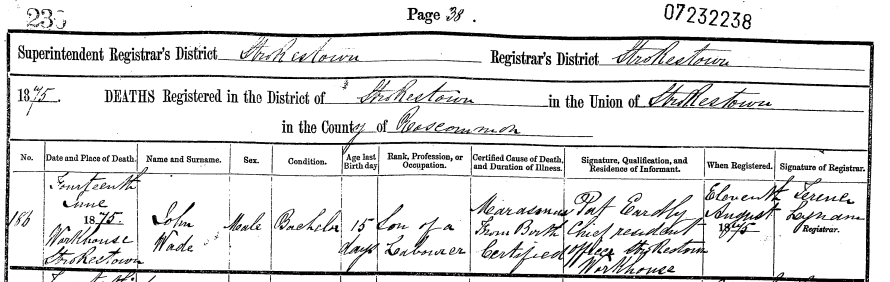
My very strong suspicion that this child was born to Henry and Ann is supported by the fact that during the period after 1864 when civil birth records were kept for Roman Catholics, the only records for the surname “Wade” in the Strokestown registration district documented other children of Henry and Ann. In other words, persons with the surname “Wade” were scarce in Strokestown by that time, and thus the record is likely to refer to a child of Henry and Ann.
While it seems odd that Henry and Ann would return to the first name “John” when they had a living son who carried that name (at least some of the time), it makes sense if “John” was simply a nickname for their son James Wade born in 1859.
- Ireland is organized into hierarchial subdivisions, much as the U.S. is subdivided into states, counties, towns, and zipcodes. In Ireland, the subdivisions are as follows: Province -> County -> Barony -> Parish -> Electoral Division -> Townland. The Townland is the smallest civil unit; there are thousands of them in Ireland, ranging from the very small to the very large. Townlands are especially important in Irish genealogical research, because the rural Irish were often identified by their townland in both civil and church records. Note that in the above hierarchy, “Parish” means “civil parish.” There are also ecclesiastical parishes, e.g., Strokestown Parish, that have demarcation lines that cut across the civil divisions. ↩︎
- It’s easy to give my Gavin first cousins an idea of the size of the Townland of Cloonfree by comparing it to the familiar Borough of Wood-Ridge in Bergen County, New Jersey. Wood-Ridge comprises an area of 1.097 square miles, approximately the same size as the entire Townland of Cloonfree (1.137 square miles). For readers who are not among my Gavin first cousins, Wood-Ridge is a small town just outside New York City where Lucy Wade Gavin, Henry a/k/a Henry Wade Jr.’s daughter, spent her final years. All of my Gavin cousins either lived in or near, or frequently visited, Wood-Ridge. ↩︎
- The witnesses are Martin Tarpy and Catherine [unintelligible]. The surname Tarpy appears in three entries in County Roscommon in Griffith’s Valuation: a Michael Tarpy in the Town of Roscommon and entries for Thomas and Patrick Tarpy in the Parish of Kilkeevin and the Townland of Cloontrask. ↩︎
 Emigrants and Immigrants